



Kids – they grow up so fast. Us – we blink and weeks disappear. Emails? They don’t stay fresh for long, either.
Like life, email marketing has a habit of moving fast. The moment an email lands in someone’s inbox, a sort of countdown begins. Interest fades, attention shifts elsewhere, and the likelihood of engagement slowly starts to decline. What looked like a high-potential campaign on Monday can become yesterday’s noise by Wednesday.
This is the reality of time decay in email marketing – the idea that subscribers’ attention and conversion potential naturally decline over time. The good news is that understanding how this decay works can help marketers improve timing, automate smarter follow-ups, and keep campaigns performing longer, rather than letting them quietly expire.
The General Concept of Time Decay
“Time decay” means a gradual reduction in value or effectiveness over time. The concept is most commonly associated with finance, particularly options trading, where an asset’s value declines as it approaches its expiration date.
The reasoning is simple: time creates opportunity. The more time available, the greater the chance that something valuable can happen. As that window shrinks, so does the potential value.
Thus, value could be thought of as a pretty “time-consuming” concept, eh?

But all jokes and abstractions aside, time decay isn’t limited to finance.
Time decay appears everywhere:
- News becomes less relevant after the first wave of attention
- Social media posts lose visibility within hours
- Trends fade once audiences move on
- Sales leads cool down when follow-ups take too long
Marketing works the same way. Attention has momentum, but momentum fades.
Understanding Time Decay in Email Marketing
When marketers talk about subject lines, segmentation, or creative testing, they often overlook a simple but powerful truth: emails lose value over time.
In email marketing, “time decay” is the gradual loss of subscriber engagement and conversion potential as time passes. Just like an options contract loses value as it approaches expiration, an email campaign loses value as relevance, urgency, and attention begin to fade over time.
As subscribers move further away from their original moment of interest, attention shifts, buying intent weakens, and the probability of conversion gradually decreases. This is why timing, follow-up sequences, and lifecycle automation are critical, because every delay reduces the “extrinsic value” of your audience’s attention.
A Few Core Takeaways:
- New subscribers are highly “volatile” and engaged
- Attention has a shelf life
- Delayed follow-ups reduce conversion odds
- Old leads lose responsiveness
- Automated nurturing slows the decay curve
In other words, the clock starts ticking the moment you hit “send.”
Theta for Marketers: Why the Comparison Actually Works
At first glance, finance and email marketing seem worlds apart. One deals with markets and contracts; the other with inboxes and customer journeys. But both rely heavily on timing, probability, and diminishing opportunity.
In options trading, traders closely monitor “theta” – the metric used to estimate how quickly time decay affects an option’s value as expiration approaches. In email marketing, engagement behaves similarly: subscriber attention gradually loses value over time, but some campaigns, audiences, and moments decay much faster than others.
This is where the comparison becomes surprisingly useful. Time decay describes the loss of engagement potential itself, while “theta” can be thought of as the rate at which that decline happens.
|
|
|||
| Option premium decays over time | Subscriber intent decays over time | |||
| Expiration date | Attention span / buying window | |||
| Theta accelerates near expiry | Leads go cold faster after peak interest | |||
| Traders manage decay | Marketers manage engagement timing |
The takeaway is surprisingly practical: timing is not just a delivery detail – it’s part of the value itself.
A great campaign sent too late can underperform. A perfectly written follow-up delayed by a few days can miss peak intent entirely. In both trading and marketing, opportunity has a lifespan, and the people who understand how quickly value declines are usually the ones who outperform.

What Time Decay Actually Looks Like in the Inbox
At a basic level, time decay in email marketing describes how engagement is strongest at the moment of attention and tends to decrease over time.
Many emails see a large share of engagement in the first day after being sent, with activity gradually tapering off over time. After the initial wave of attention, open and click rates tend to decline as the message gets buried by newer emails and competing priorities.
This decay happens faster than many marketers realize.
A subscriber who had the potential to be highly interested yesterday may be distracted today and completely disengaged next week. The offer itself may still be valuable, but the timing advantage is gone.
So… using the potential here is key.
Where Time Decay Becomes Most Visible
Time decay tends to appear most clearly in:
- Product launches,
- Limited-time offers,
- Webinar registrations,
- Cart abandonment flows,
- Seasonal campaigns,
- Lead magnet follow-ups.
It’s important to note that some email types are practically “designed to decay”. FOMO-driven campaigns, flash sales, countdown emails, and urgency-based promotions rely heavily on immediacy. Their effectiveness comes from momentum, which means their value drops rapidly once that momentum disappears.
Take the abandoned cart workflow as an example. A reminder sent within one hour often performs dramatically better than one sent two days later. The intent was strongest closest to the original action. As time passes, hesitation grows, emotional momentum disappears, or the customer simply moves on.
Engagement Is Contextual
Talking about time decay also means understanding one important thing: engagement is contextual.
People interact differently depending on:
- Where they are in the buying journey,
- How recently they showed intent,
- What currently has their attention,
- How emotionally relevant the message feels in that moment.
This is why timing changes how everything else performs.
A better subject line matters. Better copy matters. Better design matters. But timing affects the performance of all of them.
Why Decay Happens Faster Today
Modern inboxes accelerate decay even further:
- Subscribers receive more emails than ever before
- Attention spans are shorter
- Promotions compete instantly against newer promotions*
- Mobile notifications create constant distraction
* Remember this especially during promotional periods or seasons like Black Friday or Christmas.
Inboxes move quickly, and the peak time for relevance is surprisingly short.
How You Can Slow the Decay Curve
Time decay cannot be eliminated completely because it is basically an inevitability of life, and email marketing is a part of it. But! The good news is that it can be managed.
The most effective email strategies are designed around maintaining momentum before engagement fades too far.
1. Respond Quickly to Intent
The strongest signal in email marketing is recent action.
Pay close attention when someone:
- Downloads a guide
- Visits a pricing page
- Abandons a cart
- Or signs up for a webinar
All of these moments represent peak attention.
Fast follow-ups consistently outperform delayed responses because they align with existing intent rather than trying to recreate it later.
The best-performing automation flows often feel immediate, not because they are aggressive, but because they are contextually relevant.
| PS! The same principle applies to new subscribers. Right after someone joins your list, attention and curiosity are at their highest. Wait too long to follow up, and that initial momentum begins to decay. |
2. Build Lifecycle-Based Automation
Continuing from the last tip, automation helps reduce the gaps where decay happens. Instead of relying entirely on one-off campaigns, focus on structured, ongoing communication flows.
Build sequences that maintain engagement over time:
- Welcome sequences (for new subscribers),
- Onboarding emails (for new users getting started),
- Nurture campaigns (for building long-term interest),
- Post-purchase emails (for customer retention),
- Re-engagement campaigns (for inactive subscribers)
These systems keep subscribers moving rather than leaving them inactive long enough to cool off completely.
In a sense, lifecycle automation acts like “decay management.” It extends the useful life of attention.

3. Segment Based on Freshness
Not all subscribers decay at the same speed.
Someone who clicked yesterday behaves differently from someone who has ignored emails for six months. Yet many campaigns still treat both audiences identically.
Engagement recency matters.
Segment subscribers based on:
- Recent activity
- Purchase behavior
- Signup timing
- Engagement frequency
This allows you to adapt messaging before interest fades further.
Fresh leads typically respond to momentum-driven messaging, while older audiences may need stronger incentives or reactivation campaigns.
4. Create Genuine Urgency (Carefully)
Urgency works in email marketing because it acknowledges time sensitivity directly.
Deadlines, limited availability, expiring bonuses, and countdowns can temporarily counteract decay by prompting subscribers to act now rather than later.
But keep in mind that artificial urgency has limits.
If all your campaigns claim to be “ending tonight,” subscribers will eventually stop believing it. We might as well say that overused urgency creates its own form of decay: trust decay.
The goal is not panic. The goal is relevance.
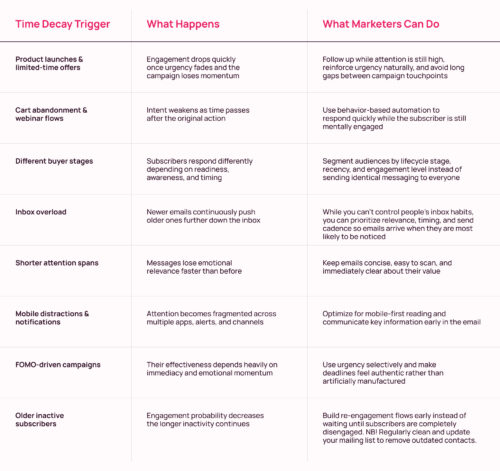
A Quick Roundup: Where Email Time Decay Hits Hardest
Here’s a short practical guide to help you spot where momentum drops, why subscribers disengage, and what to do before timing starts costing you engagement and revenue.
The Bigger Decay-Takeaway
Sometimes emails fade into the abyss quicker than we’d like to admit. Email engagement is highly time-sensitive, and time decay in email marketing is ultimately about understanding that attention is temporary.
And isn’t email marketing a bit of an investment and trade in itself?
🪙 Every campaign has a lifespan.
🪙 Every lead has a peak engagement window.
🪙 Every delay changes the probability of action.
The marketers who perform best are not always the ones creating the most content. Often, they are the ones who align their timing with moments of the highest intent. Because in email marketing, timing is not separate from strategy; it is strategy.
Plan your campaigns well in advance – the clock starts at send!