


When deciding between email, SMS, or push, the question isn’t really which channel is “best.” It’s which one makes the most sense for this particular message, for this particular customer, at this particular moment.
A flash sale that ends in two hours doesn’t have the same communication needs as a detailed product announcement. A delivery update doesn’t need a beautifully designed newsletter. And a reminder to finish something inside an app probably shouldn’t land in someone’s inbox at all.
Each channel has its own strengths, limitations, customer expectations, and level of intrusiveness. The trick is matching those characteristics to the message you’re sending.
For marketers, that means moving beyond a simple channel preference. Instead of asking, “Should we send this by email or SMS?”, ask a few more useful questions: How urgent is it? What amount of context does the customer need? How personal is the message? How often have we contacted them recently? And, importantly, what has this customer actually agreed to receive?
This guide breaks down how to make that decision, and how to use email, SMS, and push together without turning your customer journey into a notification avalanche.
Email, SMS, or Push: What’s the Difference?
Email, SMS, and push notifications can all get a message in front of a customer, but they do it in very different ways. The right choice depends less on the message itself and more on how quickly it needs to be seen, how much information it contains, and how closely it connects to the customer’s current activity.
👉 Email is the space for context. It works well when you need room to explain something, share several pieces of information, tell a story, or give customers something they can come back to later. Think product launches, newsletters, educational content, detailed offers, or onboarding.
👉 SMS is the channel for immediacy. It’s direct, personal, and hard to overlook, which makes it useful when timing matters. Appointment reminders, delivery updates, limited-time offers, and short calls to action are natural fits — as long as the customer has opted in.
👉 Push notifications are the nudge. They’re particularly useful when you want to bring someone back to an app or digital experience at a relevant moment. A reminder about an unfinished action, a loyalty update, or a personalized alert can make sense here.
Of course, the lines aren’t always this clear. An ecommerce brand might use all three channels for the same campaign, for example. The difference is in the role each channel plays.
A simple way to think about it:
- Email: “Here’s everything you need to know.”
- SMS: “This is important right now.”
- Push: “There’s something worth checking out.”
| SMS | Push | ||
| Best for | Context, education, storytelling | Urgency, reminders, quick actions | Timely nudges and app engagement |
| Message length | Flexible | Short | Very short |
| Typical urgency | Low to medium | Medium to high | Medium to high |
| Customer context | Broad | Personal and direct | Closely tied to digital activity |
| Good examples | Newsletters, launches, onboarding, detailed offers | Delivery updates, appointment reminders, flash offers | App reminders, loyalty updates, personalized alerts |
| Main consideration | Can be easy to overlook | Can feel intrusive if overused | Can lead to notification fatigue |
The real challenge for marketers, then, isn’t choosing one channel and sticking with it. It’s knowing which channel fits which customer moment.
When Email Is the Right Choice
Email is usually the natural choice when the message benefits from space, context, or longevity.
If you need a customer to understand something rather than simply notice it, email gives you considerably more room to work with.
That makes it particularly useful for:
- Product launch emails
- Newsletters
- Educational content
- Onboarding sequences
- Product recommendations
- Detailed promotions
- Event information
- Account and billing information
- Receipts and confirmations
- Longer-form customer communications
Imagine launching a major new product feature.
You could send a push notification saying, “New feature: try it now.” But if the customer needs to understand what changed, why it matters, and how to use it, email gives you the space to tell that story.
Email also has an important advantage: it doesn’t require the customer to act immediately. They can open it now, later, or return to it when they have time. That makes email particularly well suited to information with a longer shelf life.
Email works especially well when…
- The message needs explanation. If customers need context before they can understand the value, email gives you room to provide it.
- The customer may want to revisit it. Guides, event details, receipts, product information, and onboarding resources are easier to find again in an inbox than in a dismissed notification.
- The message isn’t time-critical. If nothing goes wrong when someone reads it three hours later, email is often a sensible choice.
- You want to tell a story. Email is still one of the strongest channels for combining copy, visuals, links, product information, and calls to action in one experience.
The mistake is assuming that because email gives you more space, you should use all of it. A channel can accommodate a long message without requiring one.
Sometimes the best email is still a short one.

When SMS Is the Better Choice
SMS is different because attention is part of the channel’s value.
People tend to treat text messages as more immediate and personal than email. That’s exactly what makes SMS marketing useful — and exactly why marketers need to be more selective with it.
SMS is particularly effective when the message is:
- Time-sensitive
- Highly relevant to the individual
- Simple enough to understand quickly
- Connected to a clear action
- Useful without much additional explanation
Think delivery updates, appointment reminders, limited-time offers, back-in-stock notifications, or a short reminder about something the customer has already shown interest in.
If a customer has an hour to claim an offer, sending an email and hoping they’ll happen to check their inbox might not be the best use of the channel. A text can make more sense. But there is a flip side: SMS has a much smaller margin for irrelevance.
An irrelevant email might sit unopened in a crowded inbox. An irrelevant text can feel like an interruption.
That’s why frequency, timing, segmentation, and permission matter so much with SMS. Salesforce similarly emphasizes that SMS should be treated as a highly personal channel where permission, timing, and relevance are central to the customer experience. SSalesforce
SMS works especially well when…
- Timing matters. If the customer needs to know something soon, SMS can be appropriate.
- The message is concise. SMS isn’t the place for a five-paragraph product explanation.
- The action is simple. “Your order is ready,” “Your appointment is tomorrow,” or “Your offer expires tonight” are naturally suited to the format.
- The customer has demonstrated strong intent. A customer who has just requested a restock alert has given you a much stronger reason to send a text than someone who simply created an account six months ago.
The golden rule is simple: don’t use the immediacy of SMS just because you can. Use it because the customer benefits from it.
When Push Notifications Make More Sense
Push notifications are often misunderstood as a smaller version of SMS. They’re not.
Their biggest advantage is the connection between the notification and the digital experience behind it. A good push notification doesn’t just tell someone something. It gives them a reason to return to your app or website.
That makes push particularly useful for:
- App-related reminders
- Personalized recommendations
- Order or delivery updates
- Loyalty and rewards updates
- Back-in-stock alerts
- Price or availability changes
- Behavioral reminders
- Progress updates
- Time-sensitive in-app events
For example, imagine a fitness app reminding someone that they’re one workout away from reaching their weekly goal.
That’s a natural push notification. The message is short, timely, personalized, and leads directly back into the product.
The same message could work as an email, but it would create a different experience. The customer doesn’t necessarily need a detailed explanation – they just need a useful nudge.
There is one important limitation: customers need to have enabled push notifications for the relevant app or web experience. That makes permission and relevance especially important. If every little update triggers a notification, customers can quickly tune them out or turn notifications off altogether.
Push works especially well when…
- The message is connected to an app or digital product.
- The customer’s behavior provides useful context, such as when they started something but haven’t finished it.
- The message is useful in the moment rather than something the customer needs to read later.
- The desired next step happens inside the app, making the notification a natural bridge back to the product.
| A useful mental shortcut is:
Email explains. SMS interrupts. Push reconnects. This isn’t an absolute rule, but it’s a helpful starting point for deciding where a message belongs. |
Important Things to Consider When Choosing a Channel
Once you understand the basic differences between email, SMS, and push, the actual channel decision comes down to a handful of things. Before sending, consider the following aspects.
1. Urgency
Start with a simple question: Does the customer need to see this now?
A week-long promotion can comfortably live in email. A sale ending tonight might also benefit from SMS or push. A one-hour flash sale is a much more natural fit for a highly targeted, opted-in SMS or push notification.
This is also where FOMO (fear of missing out) comes into play. A little urgency can encourage action, especially when an offer genuinely is time-limited, or availability is limited. But if every message is “urgent,” “last chance,” or “ending soon,” the effect wears off, and customers may start tuning those messages out.
In other words, use urgency when the customer actually has something to miss, not simply to make a campaign feel more urgent.
2. How Much Context the Message Needs
Short, straightforward messages can work well as SMS or push. If customers need several paragraphs of explanation, email will usually give you more room to communicate clearly.
The question isn’t just “Can we fit this into an SMS?” It’s “Can the customer understand and act on this without the missing context?”
If not, give the message more room.

3. Customer Relationship and Relevance
The same message can feel useful to one customer and completely out of place for another.
Consider how recently they’ve interacted with you, what they’ve done, what they’ve purchased, and whether they’ve engaged with that particular channel before.
A delivery update sent to someone who ordered yesterday makes sense. A promotional text sent to someone who purchased once two years ago is a very different proposition.
The more relevant the message is to the customer’s current situation, the more natural the communication feels.
4. Frequency and Overall Message Load
Don’t look at email, SMS, and push in isolation. Customers experience them as communication from one brand.
Five emails in a week may feel very different from five SMS messages or five push notifications. Even if every individual message seems reasonable, the combined experience can become too much.
The goal isn’t to maximize touchpoints. It’s to make each one useful.
5. Consent and Preferences
Having someone’s email address or phone number doesn’t automatically mean you can use every channel for every type of communication.
Track what customers have actually opted into, and make it easy for them to change those preferences.
This is particularly important for SMS and push, where channel-specific permission and customer expectations matter. Requirements also vary by market, so your messaging strategy should account for the regulations that apply to your audience.
6. Transactional vs. Marketing Messages
Before choosing a channel, consider why you’re sending the message, and consider the difference between transactional emails and marketing emails.
An order confirmation, delivery update, password reset, or appointment reminder serves a different purpose from a promotion, product launch, or win-back campaign.
Keeping these categories separate helps with customer expectations, automation, suppression rules, reporting, and compliance.
7. Using Multiple Channels
Doing multichannel marketing doesn’t mean sending the exact same message everywhere. Instead, give each channel a role.
For example:
- Email: Explain a new product and its benefits.
- Push: Remind an active app user about it.
- SMS: Reach an opted-in customer when there’s a genuinely time-sensitive reason to act.
One campaign can involve several channels, but adapt the message to each one. Think orchestration, not repetition.
A Simple Email, SMS, or Push Decision Framework
When you’re unsure, run the message through these questions:
- Is it genuinely time-sensitive?
If yes, consider SMS or push. If not, email may work well. - Does it require explanation?
If yes, email is likely the better fit. - Is it connected to an app or digital action?
If yes, push may be a natural choice. - Does the customer need to act immediately?
If yes, consider a more immediate channel. - Has the customer opted into that channel?
If not, don’t use it for marketing. - Have you contacted them recently?
If yes, consider whether another message actually adds value. - Does it fit the customer’s relationship with your brand?
If not, reconsider the audience, message, or channel.
You don’t need a complicated scoring system for every campaign. In most cases, urgency, context, relevance, frequency, and permission will get you to the right answer.
A Practical Channel Matrix
For day-to-day campaign planning, a simple matrix can make the decision even easier.
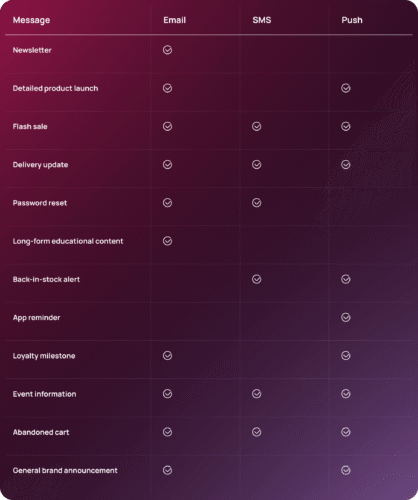
These aren’t hard rules. They’re starting points.
For example, an abandoned cart might be an email-first journey for one brand and a push-first journey for another. The right sequence depends on customer behavior, consent, timing, and the nature of the purchase.
The goal is not to find a universal answer. It’s to build a repeatable decision-making process.
Email, SMS, or Push: It’s All About the Moment
Email gives you room for context. SMS brings immediacy. Push connects a timely message with a digital experience.
Whether to choose email, SMS, or push – the right choice comes down to a few simple questions: Is it urgent? Does it need context? Is it relevant to the customer’s current activity? Have they opted in? And have you already contacted them enough?
Rather than using a channel simply because it’s available, match the channel to the moment.
When you get that match right, every message has a better chance of reaching the customers’ world and turning attention into action.