



When people talk about the future of email marketing, the conversation usually drifts toward automation and AI. Will marketers still be needed in a few years? Will AI write emails, send them, and even interpret results on its own? Well, I don’t believe the question is that simple.
I started as a developer. At the beginning, I wasn’t a great marketer (just like many other developers, actually). At the same time, marketers are often not strong in technical execution. And email marketing sits exactly in between these two worlds.
Over the last 20 years, I moved from writing code to building software for email marketers. That shift turned me into someone who understands both sides. Because of this, I see email marketers as a hybrid role. They are people who need to understand HTML and rendering constraints, integrations and data systems, customer behavior and segmentation, messaging, personalization, and business goals.
In this article, I’d like to step back and look at email marketing strategy as a system: what we actually do, how we measure success, and what it means to be effective in this field.
Email Marketing Strategy Is a Map, Not a Manual
Early in my career, someone asked me to create a strategy for them. I tried and created a strategy document, over 100 pages long. It explained everything: direction, steps, priorities. It looked perfect. The client appreciated it, printed it, and placed it on their desk.
But in reality, only about 5% of it was ever implemented. That experience taught me something important: most early-stage strategy work becomes waste. And the reason is not that something was wrong with it, but that it focused on too many details too early. The real world changes faster than our documents.
This is where LEAN email marketing comes in handy: avoid waste, constantly improve, and deliver just-in-time.
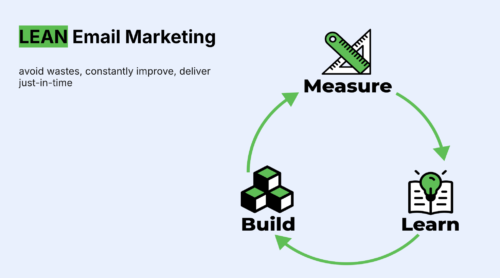
While creating a marketing strategy, it’s useful for teams to focus on a general direction and core steps to this goal:
- Where are we now?
- Where do we want to go?
- What are the next 3–5 steps?
Everything else should evolve dynamically. It’s like we navigate in real life: the direction stays the same, but the route can change because of traffic jams or road accidents.
Learning Through Practice: Shu–Ha–Ri
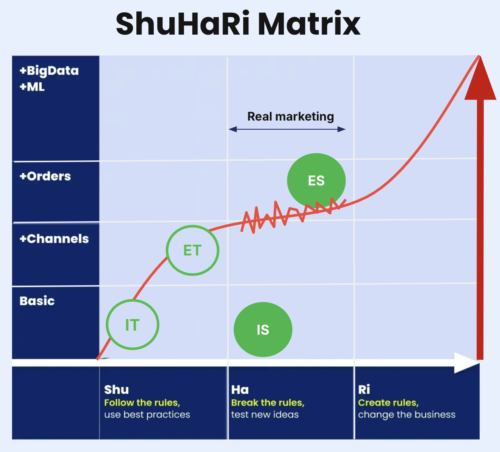
There is a useful philosophy from martial arts that applies well to email marketing: Shu–Ha–Ri. It helps you assess how good you are at anything you do. This philosophy is based on three stages:
- Shu: Follow the rules, use best practices: Here, you listen to experts and execute best practices correctly. In my experience, revenue in email marketing actually comes from this stage. Welcome flows, seasonal campaigns, and birthday offers are not exciting, but they work.
- Ha: Break the rules, test new ideas: Now that you have experience and understand your conditions, you can start experimenting and challenging patterns you learned before.
- Ri: Create the rules, change the business: Here, you understand something completely new and can build your own direction based on the business context.
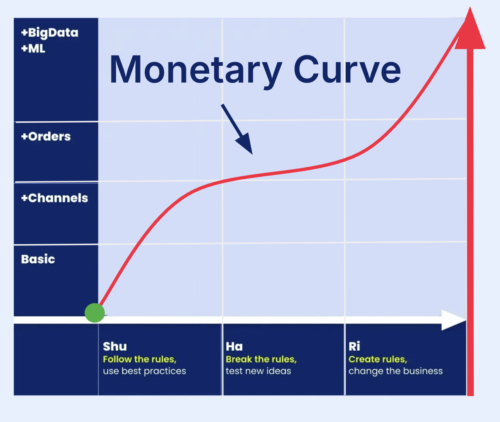
4 Levels of Data by Availability and Integration Complexity
A successful email marketing system is simple in theory:
Send the right message to the right person at the right time in the right context, in the right language, through the right channel.
The difficulty is understanding what “right” means in practice. And for that, we need data. We can think of it in levels based on how easily it is available and how rich it is.
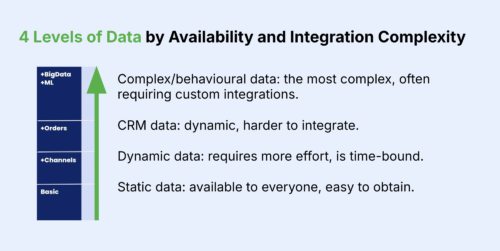
Level 1: Basic Data
This is the starting point:
- Email address
- Name
- Date of birth
- Job title
With this static data, you can already do basic segmentation and send campaigns.
But before any advanced thinking, there are basics that must be in place:
- Deliverability setup
- Domain authentication
- Sender reputation
- Infrastructure readiness
Then comes execution. Here’s an example of what you can do on the Shu stage:
- Welcome series
- Seasonal promo
- Flash sale notifications
- Product launch announcement
- Birthday or anniversary offers
- Customer appreciation emails
- Clearance sale alerts
- Holiday gift guides
- Event invitations
At this stage, the goal is stability and consistency. Only after that do we move toward optimization.

Level 2: Channel Data
At this level, you add the channel integration and understand interaction:
- Opens
- Clicks
- Unsubscribes
- Spam complaints
Now you begin to see behavior inside email communication. You can start interacting with subscribers based on their previous email activity:
- Win-back campaigns
- Feedback and review requests
- Re-engagement campaigns
- User inactivity reminders
- Milestone emails
- Click-based triggers
- Sending time optimization
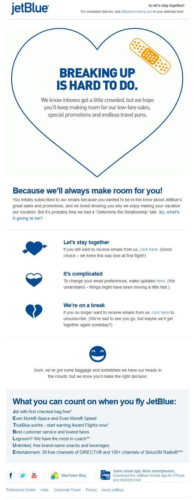
Level 3: CRM & Business Data
Here we move closer to business reality and add your CRM data:
- Purchases
- Activity history
- Loyalty programs
- Bonuses and rewards
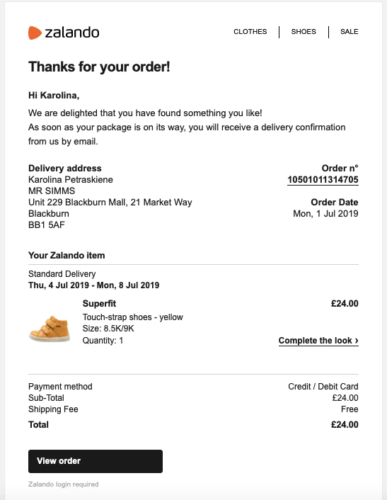
Now email is connected to real customer value. When we have data about purchases and understand the customer lifecycle, we can do the following:
- Order confirmation and shipping updates
- Post-purchase upsell/cross-sell
- Personalized product bundles
- Price drop alerts
- Customer lifecycle triggers
- Replenishment reminders
- Customer satisfaction and review requests
- Loyalty program invitations
- Membership renewal reminders
Level 4: Behavioral Data
The most advanced level, where you understand your subscribers’ behavior and can make predictions:
- Website behavior
- Browsing history
- Category views
- Social or cross-channel signals
At this point, communication becomes truly contextual and predictive. With this level of data, you can send more personalized messages:
- Product recommendations
- Browse abandonment emails
- Abandonment cart emails
- Re-engagement with personal offers
- Advanced segmentation and predictive analysis
- Loyalty tier upgrade notifications
- Shopping cart price match offers

Email Marketing Maturity Is Not Linear
One important clarification: data maturity and Shu–Ha–Ri are two independent dimensions. Data levels describe the depth of information available about customers. Shu–Ha–Ri describes the maturity of the marketer and the organization.
A company can operate at the highest data level while still being in Shu, simply by implementing proven best practices. Likewise, a company with limited data can still experiment and learn through the Ha stage.
Together, these two dimensions create a maturity matrix that helps marketers understand both what data they have and how effectively they are using it.
One of the most common mistakes companies make is assuming that email marketing maturity is a simple progression from basic campaigns to advanced personalization.
In reality, maturity develops across two dimensions:
- The depth of available data
- The level of mastery represented by Shu, Ha, and Ri
This means that abandoned cart emails, browse abandonment campaigns, and machine-learning recommendations do not automatically place a company at a higher maturity level. They may still be part of Shu if they are simply best practices being implemented.
The real progression happens when organizations move from implementation to optimization, experimentation, and ultimately to creating their own strategic approaches.
The Real Work: Removing Waste
At this stage, you already have a lot of data, and you usually spend a lot of time processing it. Now, you are at the point where you have collected data, created new processes, and built the system. As systems grow, complexity grows with them. Teams add more triggers, more emails, more workflows, and suddenly, they are overloaded.
So before the next step, you need to free your time and optimize the work:
- Remove everything that doesn’t work and brings no value or ROI.
- Automate routine tasks and minimize connections to reduce chaotic, time-consuming interactions. If every email requires multiple approvals, screenshots, Slack threads, and manual coordination, the system is broken.
- Optimize templates and maintain a reusable asset library (which modules you have, their variations, when to use them, and who can edit them). Good email design systems make it difficult to do the wrong email.
- Adopt collaboration tools and implement feedback loops. Instead of fragmented communication (screenshots, feedback loops, disconnected tools), we need real-time collaboration where teams can edit emails, comment directly, see the version history, and resolve changes in context.
- Leverage AI tools to automate repetitive tasks and free some time for strategic work.
Moving Beyond the “Shu-Level”: Email Testing
Now that you’ve understood data levels and organized your time on the Shu-stage, what’s next? It’s time for the Ha-level, a place where real marketing starts. It starts when we stop asking: “What should we test?” and start asking: “What should we learn?” And more importantly: “What will we change if we learn something new?”
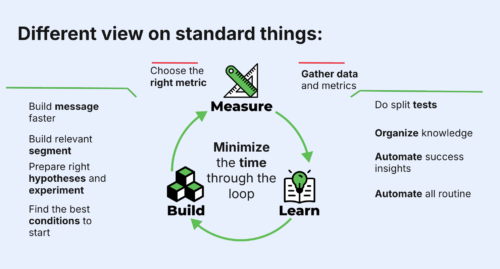
It’s a place where your experimentation becomes meaningful. Bad experiments only answer “what works,” while good experiments explain “why it works.”
For example:
- Does button color matter, or is it context?
- Does urgency improve conversion, or only in specific cycles?
- Does personalization help, or does it depend on data quality?
Without understanding “why,” your successes cannot be replicated.
Here are some common testing mistakes you should avoid:
- Testing multiple elements simultaneously
- Testing period shorter than the full user interaction cycle
- Testing on too small a sample size
- Ignoring seasonality or time of day
- Running multiple tests simultaneously on the same audience
- Ignoring audience segmentation
- Changing parameters during the test
- Testing too small changes
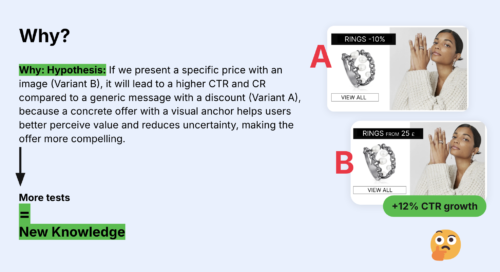
There are also three important steps to take before you start testing:
- Objectives: Clearly define what you’re testing and the purpose behind it.
- Hypothesis: Create a testable prediction about the expected outcome.
- Success criteria: Establish what results would be meaningful enough to inform your decisions.
Metrics: Measuring the Right Things
One of the biggest problems in email marketing is that companies often hire marketers for strategic goals but measure them using tactical metrics. For instance, we say: “Improve retention.” But then we evaluate performance using opens, clicks, and campaign revenue. These are not the same thing.
Open rates do not necessarily mean engagement. Revenue spikes do not always mean healthy long-term growth. Aggressive campaigns can produce short-term revenue while damaging customer loyalty.
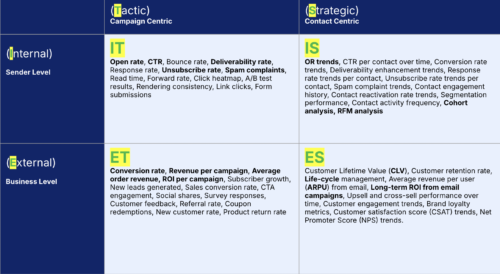
That is why I divide metrics into:
- Tactical vs. strategic
- Internal (sender level) vs. external (business level)
Tactical Metrics:
- Opens
- Clicks
- Delivery rate
- Bounce rate
These metrics describe campaigns.
Strategic Metrics:
- Lifetime value
- Customer retention
- Acquisition cost
- Customer journey quality
- Satisfaction
Strategic metrics describe business impact. They are harder to measure, but they are closer to real success.
And the gap between these metrics is where most misalignment happens.
Why Email Metrics Can Be Misleading
It’s wrong to assume that metrics always mean what they seem to mean. Most teams look at numbers without enough context and then draw wrong conclusions from them.
- Open ≠ read: Sometimes the image was simply loaded automatically. Or it was not even a human action. Especially today, with privacy protection and automated systems, opens are less and less reliable as a measure of real engagement.
- Low deliverability can absolutely indicate technical problems or reputation issues. But high deliverability does not automatically mean people care about your emails. Your messages can land perfectly in inboxes and still be completely ignored.
- Clicks ≠ interest. Clicks can happen for many reasons: curiosity, mistake, or even an unsubscribe.
- Unsubscribe rate ≠ bad content. Sometimes the issue is timing or frequency. Or the recipient actually likes the brand but simply receives too many emails.
- Spam complaints ≠ irrelevant to the audience. It can also signal unclear unsubscribe options, aggressive sending frequency, or poor expectation setting during subscription.
- Conversion ≠ success. Maybe the campaign attracted one-time discount hunters who will never buy again. Or it generated short-term revenue while hurting long-term customer loyalty.
- Low conversion ≠ bad email. The problem can be with the wrong audience or a weak offer.
- Revenue per campaign ≠ success. A campaign may generate excellent short-term sales while damaging retention, overusing discounts, or exhausting your audience.
Different Email Marketing Stages Require Different KPIs
A marketer working on foundational execution should not necessarily be measured the same way as someone focused on experimentation and optimization.
At earlier stages, important KPIs may include:
- Implementation progress
- Process stability
- Campaign consistency
- Execution speed
At advanced stages, what matters more is:
- Learning velocity
- Quality of hypotheses
- Experimentation discipline
- Optimization efficiency
- System improvement
Final Thoughts
I do not think email marketers are becoming less important. Instead, their role is becoming more strategic. The future belongs to marketers who can build adaptive systems, reduce operational waste, learn continuously, and evolve strategy through experimentation.
So my main advice is simple: Stop spending enormous amounts of time building perfect strategy documents upfront. Instead:
- Implement the fundamentals
- Stabilize your systems
- Automate repetitive work
- Free time for thinking
- Test constantly
- Let your strategy evolve through learning
Remember that your strategy is not a static document but a map for reaching your destination via different routes.
About the Author
 Dmytro Kudrenko is an entrepreneur with over 25 years of experience in software development, including 15 years in email marketing. As the founder and CEO of Stripo, he’s an expert in email marketing automation and a certified specialist in lead management and email messaging by Meclabs. Given how valuable modern emails can be, Dmytro focuses on helping marketers create these emails quickly and without coding.