



Ah, yes, who doesn’t recall an advertisement from past times, maybe even 20 years ago, that was humorous and (obviously) memorable? Welcome to Planet Advertising, where humor has been relied on since the beginning of time to fulfill two important business goals: attracting potential customers’ attention and creating positive emotions that they associate with the brand.
In this article, we will look, quite seriously, a little closer into the world of jokes. Does the combination of this and email marketing fit nicely in the universe, or can we sometimes expect a collision instead? What is humor in email marketing, and when is it necessary? Or is it even? Let’s get the ball rolling.
History of Humor in Marketing
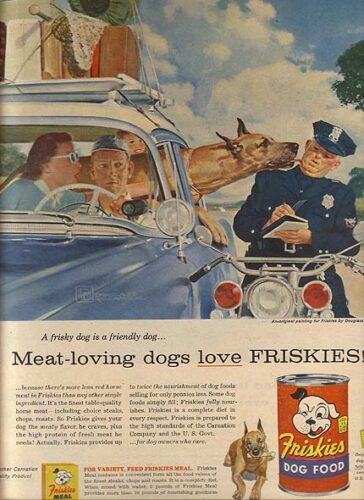
In general, humor has been a cornerstone of marketing for over a century, evolving alongside media and consumer culture. In the early 1900s, print ads began using witty slogans and playful illustrations to capture attention. The advent of radio in the 1920s saw the rise of humorous jingles and characters, such as the iconic “Pepsodent Show” featuring Bob Hope. Television further amplified humor’s role in marketing, with memorable campaigns like Alka-Seltzer’s “Plop, plop, fizz, fizz” in the 1960s and the witty “Got Milk?” ads of the 1990s.
The digital age brought humor to new heights, with viral internet campaigns and social media giving brands a platform to engage audiences with quick-witted posts and memes. Brands like Old Spice and Dollar Shave Club have become modern exemplars of humor in digital marketing, using straight-up comedy to become instantly memorable and build strong brand identities.
As we move forward, the integration of humor in marketing continues to adapt, with email marketing being a key channel for engaging audiences with clever and amusing content. Next, let’s look at some great humorous examples in email marketing. But of course, after taking a (really too short) detour into the psychology of humor in general.
The Brief Psychology Behind Humor in Ads
In ethological terms, humor can be seen as exposure to a humorous stimulus that facilitates further social activity. In a personal situation, having a laugh makes the atmosphere more fun, but if the joke is made carelessly, it may create unbearable awkwardness instead. In a marketing situation, good humor means the salesperson gets closer to sealing the deal, but when the joke is delivered poorly, they may lose the client and even damage their brand’s reputation.
Coming to the biological side of it all, fMRI studies indicate that various brain regions, including the prefrontal cortex and amygdala, are activated during the processing of humor. These regions are commonly linked to cognitive functions such as social perception and emotional responses. When people laugh, they release endorphins, fostering a sense of happiness and connection.
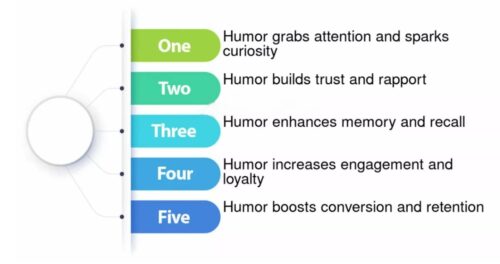
Humor in advertising works by (hopefully) initiating positive emotions, which enhances brand recall and consumer engagement. This positive association with a brand increases the likelihood that customers will remember and favor it.
Let’s think about who we laugh with the most. Largely, humor is related to close people and closeness in general, so “laughing together” with a brand can act as a bonding experience. Additionally, humor can lower resistance to marketing messages by making ads more enjoyable and seem less intrusive. You are not pressured into purchasing the product – the decision you make in these high spirits seems to be totally your own.
Given the clear advantages of humor in marketing, let’s explore how this delightful approach has helped brands succeed with engaging email campaigns that resonate with both writers and readers alike.
When Did Marketing Emails Become Funny?
The use of humor in email marketing intensified in the early 2000s as brands sought new ways to engage with their audiences. With the rise of email as a primary communication channel, marketers realized that incorporating humor could make their messages stand out in those already crowded inboxes. By the end of the decade, humor had become a key technique for engaging audiences.
One of the standout adopters of humor in email marketing was Groupon, a global e-commerce marketplace that launched in 2008. Known for its witty and often irreverent style, Groupon’s emails featured humorous subject lines and quirky content that entertained subscribers while promoting deals. From subject lines like “There are no deals in this email” to leading (potential) unsubscribers to view a video of the “humiliation” of a poor Groupon employee responsible for their sign-up, Groupon’s approach helped the company rapidly grow its subscriber base and set a precedent for other brands to follow. Their email marketing truly shaped to be one of the legendary ones in the field, and humor was a big part of the recipe.
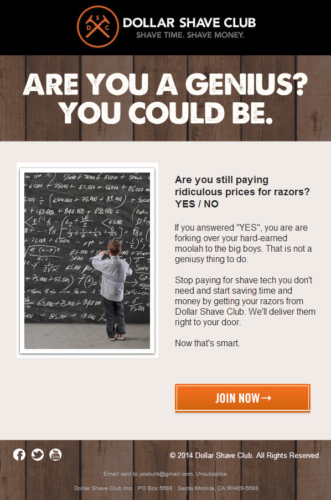
Another notable example is the personal grooming products company Dollar Shave Club. Their 2012 launch email was accompanied by a humorous video starring their founder, Michael Dubin, that (for obvious reasons) quickly went viral, showcasing the brand’s personality and setting the stage for their email marketing strategy. The fact that the founder actually had attended comedy classes is evident, while the success of this campaign proved how powerful humor can be in creating memorable, shareable content. Overall, Dollar Shave Club is known for its amusing emails, from subject lines like “Hey babyface, not so hairy?” to bold-styled copywriting that’s quite experimental with boundaries.
What was next for the company? In under five years, it grew from a one-man business to more than 600 employees. In 2015, Unilever acquired the company for $1 billion, allowing the founder to still stay in control. And now, Dollar Shave Club enjoys revenues of $250 million and has four million subscribers.
As email marketing evolved, more brands discovered that humor isn’t just for laughs – it’s for building relationships. Today, many companies regularly use humor to create engaging email campaigns that entertain their audiences. Wendy’s is known for its witty tone that often pokes fun at competitors, Nike for its subtle, dry humor, and Spotify for its use of hilarious copy in its famous wrapped campaigns. Frankly, the list could go on with businesses that have pulled a few pranks as part of a campaign here and there.
Is It All Funny Though?
On the other hand, many businesses remain hesitant to incorporate humor into their marketing campaigns, which is something consumers miss. According to the Happiness Report study conducted in 2022, 91% of people prefer brands that use humor, and 72% are more likely to choose a brand that embraces it. However, the same study revealed that 95% of business leaders are still afraid to use humor in customer interactions. All we can hope for is that this absence of fun might just be a recent trend and that brands will begin to embrace a more humorous approach again.
In the hopes of this, let’s see what kind of ways you can make your subscribers laugh, and also give you some hints on what you should avoid.
Different Types of Humor
Before we talk about how you can make subscribers giggle, we have to look at the various main styles of humor one could use.
| Slapstick (Physical Comedy) | This type of humor relies on exaggerated physical actions such as pratfalls, slips, and visual gags. Think about popular classic comedies, cartoons, and silent films. The banana peel is probably the most well-known keyword here. You can find slapstick jokes in children’s entertainment or in content that purposefully does not take itself too seriously. In intellectual or high-brow settings, slapstick is usually nowhere to be found. |
| Satire | Uses irony, sarcasm, and ridicule to criticize or highlight societal issues, politics, or cultural norms. Popular in news parody shows and editorial cartoons. Often avoided in highly formal settings or where neutrality is required, such as in certain corporate environments. |
| Dark Humor (Black Comedy) |
Deals with taboo subjects like death, tragedy, or existential concerns, often in a light or ironic way. Seen in cult-favorite shows and movies like South Park or Fleabag, and widely popular in meme culture with younger audiences. Usually unsuitable for content concerning or aimed at children, conservative settings, or sensitive industries like healthcare and family. |
| Self-Deprecating Humor | Involves making fun of oneself, often by highlighting personal flaws or mishaps. Common in stand-up comedy and personal blogs. Rarely seen in formal or highly professional environments, as it may appear unprofessional (by now, this list seems to suggest that professional environments tend not to be very fun). |
| Surreal/Absurd Humor (Nonsense Humor) | Based on bizarre, irrational, or unexpected juxtapositions that don’t necessarily make logical sense. Think about those legendary TV shows like Monty Python and The Mighty Boosh. This kind of humor is rarely used in traditional, logical, or straightforward contexts like business presentations or propositions, but it may work wonders in creative marketing. |
| Dry humor (Deadpan) | Delivered without showing any emotion, often with a serious tone that contrasts with the absurdity or irony of the content. Frequently heard in stand-up or British humor, which is, of course, absolutely fabulous when it comes to joking. Deadpan humor is less common in animated or high-energy settings, as it is based on subtlety. |
| Witty humor | Similar to dry humor, this humor type involves quick, intelligent remarks, often wordplay or double meanings. Common in literature, sitcoms, and social gatherings. It’s not typically found in slapstick-heavy content or lowbrow comedies. |
| Parody (Spoof) | Mimics the style or format of a work, genre, or artist for comedic effect. Think Scary Movie or Spaceballs, or shows like Saturday Night Live and The Simpsons, which use parody to highlight life’s absurdities and comment on culture. Though rare in serious journalism, parody blends humor with social insight, shaping how we see the world. |
| Juvenile Humor (Bathroom Humor) | Revolves around crude jokes, bodily functions, or immature themes. Popular in certain comedies and other content aimed at younger audiences. It is basically never used in professional settings or intellectual entertainment. |
| Sarcasm and Irony | Both involve expressing a meaning opposite to what is stated, but they differ in tone and purpose.
Irony is a broader concept that often highlights a contrast between expectations and reality, such as in situational irony, where outcomes are unexpected. Sarcasm, on the other hand, is a form of verbal irony where someone says the opposite of what they really mean, usually with a mocking or contemptuous tone. In essence, all sarcasm is ironic, but not all irony is sarcastic. Irony is often used in literature, movies, and speeches for humorous or emphatic effect, but is less suited for straightforward or factual contexts such as news reporting. Sarcasm is common in everyday conversations and TV shows, but can feel unprofessional in formal settings. |
| Wordplay (Puns) | Plays on the multiple meanings of words or similar-sounding words for comedic effect. Popular in written humor, children’s jokes, and certain TV shows. Often avoided in formal or academic content. Wordplay is very popular in marketing content, and a good example from email marketing is using clever puns in the subject line to grab attention. |

The First Things to Figure Out Before Using Humor in Your Campaigns
Surely, there are many ways to make people laugh and many outlets to do so; the outlet determines the manner you should use. For your marketing emails, it is important to consider whether your joke fits the context of your campaign, the product or service you’re selling, the cause you’re driving, or if you are slipping on a banana peel when telling it. The coherence between the humor & your product, plus your audience, is key. Will your presentation uplift both moods and sales, or does your offer leave them laughing, maybe even unsubscribing to see you never?
Here Are Two Questions to Consider:
1️⃣ First thing, what is the product that you sell, or what is the other purpose of sending this marketing email? Do you sell wellness products to really tired people with critically fast-paced lives? Or are you inviting young people suffering from excitement deficiency to your newly opened arcade? Or maybe it’s a nonprofit email, rallying people to join the next big cleanup effort?
— Afterthoughts: Would satire that’s critical of new-age mindfulness be appropriate in your wellness products email and help create that pre-purchasing bliss in the minds of your readers? Would short, dry humor backed by a minimalist email design do you any favors if you want to promise people excitement and make them click the booking CTA right away? Would combining juvenile humor with your appeal to save the environment make people take your cause seriously?
2️⃣ Secondly, who is your target audience or average subscriber? In other words, who are you writing your message to? Maybe they are poetic souls inclined to melancholy or “seriousness” who are interested in thought-provoking content and a helpful publication that unravels the world. Perhaps they are young adults who are full of enthusiasm and show great activity in socially important matters. Or maybe they are a diverse group of people who just want sincere, silly joy from the content you share and pure entertainment from the goods you sell.
— Afterthoughts: One thing is for sure – the portion of humor in every email you write will vary greatly depending on your audience. For people whose purpose of subscribing is to think along with your content, a dry pun here and there can help refresh their spirit for a second. For those doers and future-builders, you can consider a vibrant tone and more frequently occurring jokes as long as you keep your focus on the main purpose of your email, which is motivating action. And if you’re making the world a better place by sharing content and products that bring people authentic joy, why not deliver it with simple slapstick humor?

The Dollar Shave Club Example
To sum this up, let’s get back to Dollar Shave Club’s marketing for a moment here. Let’s think about how such a straightforward, quite arrogant approach to humor worked and became so successful.
Apparently, the target group of this company plays a big role in this dynamic. In this instance, they’re a relatively clearly defined demographic group that is likely to respond well to this type of “no bullsh*t” humor. Additionally, due to the type of products they’re selling, the prevailing masculine attitude within the target group can create a desire to be part of the brand family.
Product: Check ✅ Target group: Check ✅
If this brand had made ill-fitting jokes in its campaign, would its target customers still want to be part of that brand community? We think not.
So, before you actually start making your marketing messages funny, you need to think about what you’re selling and who you’re selling it to.
Finding Out If and How Humor Suits Your Particular Audience
If you really want to find out whether your unique group of subscribers would accept your jokes with applause, you can take an extra step and study your client base.
Conducting Surveys
Showing that you care about your audience’s opinion is always good, and polls in marketing emails are known to work well. To conduct a survey for your customer base, you could start by selecting a representative sample of your clientele and crafting a brief, engaging questionnaire that asks about their preferences for the style of marketing communications, including the use of humor. Additionally, offering an option for customers to provide feedback on past campaigns can yield valuable insights into what resonates best with your audience.
Humor questionnaires can be very helpful for researching your client base. For example, companies could draw on the Coping Humor Scale (CHS), created in 1983 by Martin, Mittu & Lefcourt, especially if the goods they sell are designed primarily to help people and/or improve their well-being. This questionnaire measures how the respondents cope with life’s tensions through their own joking, but it also shows how effective exposure to humor is for them when they encounter problems.
Sometimes, problems can be solved with what you are selling. And if you add a joke to that, some segments (about that more below) may be more prone to buying. The Situational Humor Response Questionnaire (SHRQ), created by the same researchers, assesses the degree to which subjects laugh and smile in a wide variety of situations, and can be especially useful in determining customers’ humor preferences.
A/B Testing
Since we are talking about email marketing, we also have to mention A/B testing, which you can use to analyze your mailing list and determine what approach suits them best. A/B testing is a method in which two variations (A and B) of an email are sent to different segments of your audience to measure which performs better based on specific email marketing metrics like open rates, click-through rates, or conversions. In some cases, more than two variations (A/B/n testing) may be tested simultaneously.
When it comes to humor, A/B testing can help you determine whether your audience resonates with it or prefers a more serious or straightforward tone. By testing different styles of humor or comparing humorous content with serious alternatives, you can make data-driven decisions about its effectiveness.
Examples of A/B Test Variants for Using Humor
Variant A for a bit of humor, B for the serious version.
The Subject Line Test:
- A: “Your customer’s inbox called… it wants better emails 📬”
- B: “Improve your email marketing performance with these tips 📬”
The Content Style Test:
- A: A lighthearted email featuring a joke or playful tone: “Our [product name] is so easy to use, even your cat could try it (no guarantees on their typing skills, though!).”
- B: A professional, factual tone: “Our [product name] is easy to use, simplifying your workflow, and saving you time and effort.”
Step-by-Step A/B Testing Process:
- Choose one variable to test: Subject line, tone of the email, or even the placement of a humorous CTA. It is always a better idea to test only one variable at a time; then you can be sure you are measuring the one element you want to measure.
- Divide your audience: Instead of dividing your entire mailing list into two groups, choose two sizeable, random segments (e.g., 10-20% of your total list) that will receive versions A and B of your email.
- Send the emails: Send version A to one group and version B to the other.
- Measure results: Track key metrics like open rates, click-throughs, or conversion rates. If you need to learn more about these indicators, read our in-depth article about email marketing metrics.
- Analyze the data: Based on the performance of the two variants, send the better-performing version to the remaining portion of your mailing list, also use these insights to refine your future campaigns.
The process of A/B testing helps you not only decide whether humor is effective but also further identify the type of humor that aligns best with your audience’s preferences.
Using the Help of Segmentation
As mentioned earlier, some segments may be more likely to engage with emails or make a purchase when humor is used. While A/B testing helps you determine whether humor works for your audience as a whole, segmentation lets you go a step further by tailoring your approach to specific groups within your mailing list.
People of different ages, regions, industries, or preferences may respond to humor in vastly different ways, and segmentation enables you to address these nuances.
How to Segment for Laughs
Demographic and behavioral indicators can help you divide your audience into groups that may have distinct humor preferences. Consider the following segmentation criteria:
| Age | Younger audiences like Gen Z may appreciate memes or pop culture references, while Gen X or older audiences may prefer more subtle or traditional humor. |
| Region or Culture | Different areas may have unique humor styles or sensitivities – what’s funny in one culture may not resonate or could even offend in another. Remember, a topic that works as a small ironic joke in one region or country may be better avoided in another. |
| Industry | A playful tone might work well for creative industries like design or marketing, while more conservative fields like finance or law might prefer a formal approach. There are several aspects to consider when it comes to industry. Avoid dark humor or excessive joking in the health sector, especially when addressing social issues. |
| Past Engagement | Track which tone of previous emails led to higher engagement and create segments accordingly. |
| Interests | Use data from surveys, preferences, or behavior to identify groups who might respond better to humor compared to those who prefer a straightforward tone. |
Example of Humor-Preference Segmentation:
Group A: Young, tech-savvy audience – Use lighthearted, witty humor with modern references (e.g., wordplay, memes, or slapstick touches).
Group B: Professionals in formal industries – Keep humor subtle and professional or avoid it altogether (deadpan or irony may work if carefully done).
Group C: Loyal customers with high engagement – Experiment with inside jokes or brand-related humor they’re likely to appreciate.
👉 Additional material: For a comprehensive guide to doing this, read our article about email segmentation.
Last Laughs: Some Considerations Before You Send
If you are finally thinking about making a joke or two in your marketing emails, we’ll share some afterthoughts that can help you decide whether to use humor in your campaigns and which style could work.
At the end of the day, humor has the power to properly confirm your company’s position in the market or, well… ruin a lot of the hard work you have done so far in building your brand.
| You’re Human Too | Warm humor, light self-irony, and amusing, good-natured coverage of real-life situations can make readers feel comfortable and more connected to you because it shows you understand the good, the bad, and the ugly parts of life as they do. |
| Play Smart, Not Soft | Dry humor, satire, and a little smug chuckle about issues or current topics can make your subscribers see you as an authoritative representative of their field, while also making the subscriber feel like an insider of the (brand) group who sees things from maybe a slightly higher perspective. |
| Bills are not Funny for Anyone | Remember that transactional emails are not marketing emails, so it’s best to avoid humor there. |
| Caution for New Brands! | Humor-based campaigns are best for brands people already know. Think of humor as ‘spicy seasoning,’ not the main course (unless you’re promoting your stand-up show or have deliberately decided to make humor the core of your marketing). Why? If your brand is still unknown, building trust first should be the focus. We’re not suggesting that introducing a brand or a new product must be dead serious, but jumping straight into humor can backfire and turn your brand into a laughing stock instead of a trusted name. |
| Be Careful With Live Interactions | A study by Söderlund & Oikarinen (2018) has shown that joking with customers during real-time service encounters can reduce satisfaction, because humor may distract from the main message or interfere with understanding. That said, humor can still turn your luck around if used with awareness, clear boundaries, and careful timing. |
| Laugh With a Cause | Although it can be perceived as a style of humor with a negative undertone, satire and corrective humor are actually considered to be virtuous by nature (connected to justice, temperance), as they ultimately aim to promote improvement or highlight wrongdoing in a moral sense. This can work well for campaigns tied to moral or social causes, but approach carefully to avoid misinterpretation (Ruch & Heintz, 2016). |
| Humor in Premium-Brand Ads? | Although many premium brands avoid humor to maintain elegance and prestige, it can boost brand recall and make brands feel more approachable. To succeed, focus on appropriate, relevant messaging, optionally feature public figures, and avoid cheap jokes, discriminatory content, or off-message humor. Done thoughtfully, humor strengthens brand perception without harming status, though it may not influence purchase decisions (Powrel & H.R., 2023). |
| Error? Entertain! | Sometimes we all make mistakes. When your email campaign misfires (like sending the wrong email to a segment or accidentally using last week’s promo in this week’s email), humor can save the day. Here, an error correction email can turn a mistake into a playful, human moment that keeps your audience smiling. |
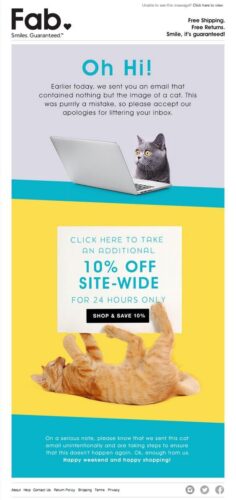
A cute and funny oops email from Fab after they first sent an email with just a cat picture to their followers. Was the first email cleverly intentional or not? We don’t know. Was the whole deal funny and memorable? It surely was, with a bonus attached.
Humor in Email Marketing is not a Laughing Matter
So, is humor in email marketing a clever trick or a risky joke? Well… both, haha.
Jokes aside, humor is one of the most powerful tools to connect with your audience – but only if you understand who you’re talking to, what you’re offering, and why. Used thoughtfully, it can turn a simple email into a memorable experience, strengthen your brand, and even make your campaigns go viral. Used poorly… well, then the joke’s on you.
The key takeaway is simple: humor should never replace your message – it should enhance it. Make your readers smile without making them question your credibility.
Humor isn’t just good for business, it’s good for people. When used right, you’re not just boosting metrics – you’re creating a small, positive moment in someone’s day. A true win-win.
In the end, humor works best when it feels natural, relevant, and respectful. Make your audience laugh with you – not at you – and they’ll keep opening, engaging, and coming back for more.